Showing posts with label Shavuot. Show all posts

Monday, May 21, 2007

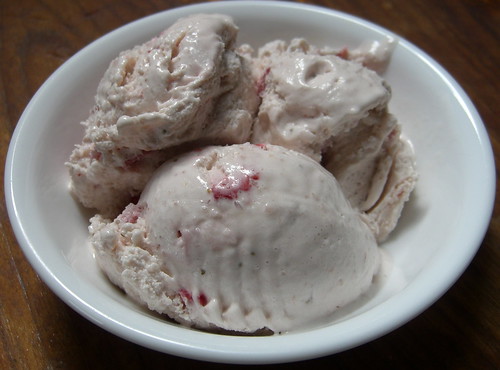
Strawberry Cheesecake Ice Cream


A friend of mine (we'll call her the Enabler) recently asked whether I'd be making ice cream for Shavuot — maybe cheesecake ice cream? I answered that I'd thought about it, but I couldn't very well make ice cream to serve with cheesecake, let alone cheesecake ice cream.

But apparently I could.

Let me explain. The cheesecake recipe we're using this year (a no-bake version, since our oven is broken) calls for 12 ounces of cream cheese. Cream cheese comes in eight-ounce packages, so we bought two and had four ounces extra — exactly the amount called for in this recipe. And strawberries are at the height of their season, so we had two pounds in the fridge. Tell me that isn't a sign from God. (Actually, don't. I prefer the illusion.)

In any case, I'm very pleased with the result. The ice cream has a mild cheesecake flavor without being overwhelmingly rich, and the fresh strawberries really hit the spot. Here's the recipe:


Strawberry Cheesecake Ice Cream
Adapted from Joy of Baking

4 oz cream cheese
3 large egg yolks
2/3 cup plus 2 tablespoons sugar (divided)
2 cups half-and-half
1/2 vanilla bean or 1 1/2 teaspoons vanilla extract (I used extract)
1 pound (about 2 dry pints) strawberries

  1. In the inner container of a double boiler (or any medium stainless steel bowl), blend the cream cheese, egg yolks, and 2/3 cup sugar with a whisk or, preferably, an electric hand mixer until light and fluffy (about 2 minutes). (At this point, you may wish to begin heating the water for step 4.)


  2. In a small saucepan, heat the half-and-half to the scalding point along with the vanilla bean, if using. (If using extract, do not add it at this point.) Stir frequently to prevent a skin from forming. When the cream reaches the scalding point, the milk will begin to foam up rapidly. Immediately remove from heat. Take out the vanilla bean and scrape the seeds out with the back of a knife, then mix the seeds back into the half-and-half.


  3. Slowly pour the scalding half-and-half into the cream cheese mixture while whisking the mixture to prevent the eggs from cooking. (If any lumps do form, force the mixture through a strainer.)


  4. Fill the outer container of the double boiler (or a saucepan) with water and bring to a boil. Place the bowl or container of custard over the simmering water and heat, stirring constantly, until the custard reaches 170 degrees F or coats the back of a wooden spoon. Remove from heat and continue to stir for a few minutes. Set aside.


  5. Cut up half the strawberries and puree them in a food processor or blender. Stir the remaining two tablespoons of sugar into the puree, then stir the puree into the custard along with the vanilla extract, if using. Cover the mixture with plastic wrap, cool to room temperature, and refrigerate several hours or overnight, until thoroughly chilled.


  6. Freeze the chilled mixture in an ice cream maker according to the manufacturer's instructions. Chop the remaining strawberries. Remove the ice cream from the machine and stir in the strawberries. Transfer to freezer to harden.


Cross-posted to the Kosher Blog.

Tuesday, June 07, 2005

Festival of Cheese

A popular but somewhat elusive Ashkenazi custom dictates that dairy products be eaten on Shavuot. Midrash Tanchuma (Ki Tissa 9) derives the custom from the idea that milk symbolizes Torah, which is based on the phrase "honey and milk are under your tongue" (Song of Songs 4:11). The land of Israel, in which the rite of presenting the first fruits of the land was performed on Shavuot, is likewise described as "flowing with milk and honey." Indeed, Central European Jews once favored honey cake for dessert on Shavuot, according to Gil Marks' World of Jewish Cooking (p. 314).

Another explanation for the practice derives from Psalm 68:16, which describes Sinai as har gevunim, a "jagged mountain." The word gevunim resembles the Hebrew word for cheese, gevinah. One kabbalistic explanation derives the custom from the gematria (numerical value) of the Hebrew word for milk, chalav, which is equal to forty, the number of days that Moses spent on Sinai. Another derives it from the first letters of the words describing the festival meal offering, minchah chadashah ladonai beshavuoteichem, "an offering of new grain for the Lord on your Shavuot festival," which together spell mi-chalav, "from milk."

Better-known than any of these is the explanation given by the Mishnah Berurah (494:3), which has it that upon returning home after the revelation of the Torah, along with the detailed "oral laws" pertaining to the slaughtering and consumption of meat, the Israelites realized that they could no longer eat the meat they had prepared or use their knives and pots, which were not kosher. Thus, they were forced to eat dairy and parve foods (presumably raw). A variant on this tradition has it that before receiving the Torah, the Israelites thought that dairy products might be considered part of a living animal, which may not be eaten according to the seven Noahide commandments. When they received the Torah and learned that milk was one of the foods with which the land of Israel was associated (e.g. Exodus 13:5), they realized that it could not be forbidden.* They immediately rejoiced with a dairy meal.

Other explanations attribute more pragmatic motives to the Israelites. According to one, the people fasted for three days in preparation for receiving the Torah. When they returned, they were so hungry that they did not have the patience to prepare meat, and resorted to eating dairy instead. According to another, receiving the Torah took so long, that by the time the Israelites returned, their milk had turned to cheese.

Yet another explanation is based on a midrash cited in the Talmud (B. Sotah 12a), which sets the date of Moses' rescue by Pharaoh's daughter at the sixth of Sivan (the date of Shavuot) and states that Moses refused to suckle from Pharaoh's daughter because she was a gentile. For this reason, Moses' mother became his wet nurse. The milk consumed on Shavuot, according to this explanation, reminds us of an important stage in Moses' infancy. An alternative explanation associates the practice with the infancy of corporate Israel, which only truly became a people upon receiving the Torah. Some describe God's granting of the Torah as an act of loving kindness, similar to that of a mother nursing her child. Others focus on the Torah itself as a fundamental source of life, analagous to breast milk. A very different explanation associates meat with a negative aspect of the Sinai experience: the sin of the golden calf. According to this explanation, Jews avoid meat on Shavuot so as not to remind God of their sin.

Perhaps the oddest explanation is based on the Zohar, which compares the seven weeks of sefirat ha-omer (between Passover and Shavuot) to the seven days following a woman's period, during which rabbinic law forbids her contact with her husband. After being separated from God through exile in Egypt, Israel (and her divine counterpart, the shekhinah) had to wait seven "clean" or "white" "weeks of days" before being purified at Sinai through knowledge of the Torah and finally reuniting with God (or, in the shekhinah's case, the aspect of God known as tiferet) in the great cosmic sexual encounter that was the Sinai theophony.** This transition from menstrual impurity to purity is described as a transformation of blood into milk (Be'er Heitev OH 494:3).

Because of the rabbinic dictum that "there is no joy without meat and wine," many observant households (not including mine) make sure to eat a meat meal on Shavuot in addition to a dairy meal. Some commentators cite this practice in their explanations of the custom of eating dairy. Thus, the Remah (OH 494:3) compares the two types of food eaten on Shavuot (meat and dairy) to the two cooked foods eaten on Passover (egg and shank bone), which commemorate the two sacrifices offered on the holiday. A variant on this explanation invokes the two leavened loaves offered on Shavuot. Alternatively, the consumption of both meat and dairy is related to the juxtaposition of the prohibition against cooking a calf in its mother's milk with the commandment to offer the first fruits of the land to God (Exodus 23:19; 34:26), a ritual performed on Shavuot in Temple times. Another explanation relates to the combination of meat and dairy served by Abraham to the three angels in Genesis 18:8. According to Midrash Rabba, the angels were angry at Moses for removing the Torah from heaven and bringing it to earth, but God prevented them from attacking him by reminding them of Abraham's hospitality. Thus, a meal of meat and dairy made it possible for the Torah to be given to Israel.

Isaac Klein, author of A Guide to Jewish Religious Practice, prefers a more rationalist explanation, which he attributes to Hirshovitz, author of Otsar Kol Minhagei Yeshurun ("Collection of all the Customs of Jeshurun"). Klein explains (p. 151): "Meat is the food of those who know no restraint.. . . Eating dairy dishes on Shavu'ot is a reminder that the Torah is given to him who lives the sober life rather than that of pleasure." (Needless to say, the dairy meals eaten in this household on Shavuot are completely out of keeping with Hirshovitz's explanation.)

The presence of so many explanations for a single custom may be a testament to the endless creativity of the Jewish people, but it also draws attention to the fact that no one of these explanations is particularly convincing (although some are highly entertaining). The most probable reason for the practice of eating dairy on Shavuot is that pastoral communities tend to produce most of their cheese in the spring, when sheep, cows, and goats suckle their young. Because of this, springtime festivals the world over tend to feature butter and cheese.

This in no way lessens my enthusiasm for the traditional Shavuot fare of Ashkenazi Jews: blintzes and cheesecake. Although I've never met a cheesecake I didn't like, I have to agree with DH that the very best recipe comes from Joan Nathan's The Jewish Holiday Kitchen.*** Beaten egg whites make this cake delightfully fluffy, without deminishing the richness imparted by the cream cheese and sour cream. Without further ado:

The Very Best Cheesecake

Ingredients:
6 tablespoons unsalted butter
1 cup graham cracker crumbs
6 eggs, separated
1 pound cream cheese
1 pound sour cream
1 cup sugar
Juice of 1/2 lemon
1 teaspoon vanilla
2 tablespoons flour

1. Preheat the oven to 300 degrees. Grease the sides of a 9-inch springform pan.

2. Melt the butter and combine with the graham cracker crumbs. Press the crumbs into the bottom of the pan. Save some crumbs.

3. Combine the egg yolks, cream cheese, sour cream, sugar, lemon juice, vanilla, and flour. Beat very well until light and fluffy.

4. Beat the egg whites until stiff peaks form. Fold into cream cheese mixture. Pour the batter into the pan and sprinkle with the remaining graham cracker crumbs.

5. Bake 1 hour. Turn off oven and leave cake in the oven 1 additional hour. Then leave the oven door ajar 30 minutes more.

Chag Sameach!

*This line of reasoning comes from B. Berachot 6b.
**This encounter is repeated each Shavuot at halakhic midnight. You can catch it by staying up for the traditional all-night Torah learning session, or tikkun.
***In fact, it was tasting this cake at my in-law's that convinced me that I had to buy the book.
Friday, May 13, 2005

Emor: Rabbinic Mathematics

[Note: I've altered this post somewhat since Shabbat. Persons by the name of Meredith are requested not to read the footnote.]

Today is the 19th day, that is, two weeks and five days in the counting of the Omer.

The commandment to count the omer (sheaves of wheat), in both days and weeks, comes from a literal reading of Lev. 23:15-16:

You shall count off seven full weeks from the day after the Sabbath, the day after you bring the sheaf (omer) of elevation. You shall count until the day after the seventh Sabbath, a total of fifty days; then you shall offer new grain to the Lord.

Although the sheaves and grain can no longer be offered, rabbinic tradition retains the practice of counting these forty-nine days, which are followed, on the fiftieth day, by a festival (Lev. 23:21), elsewhere called Shavuot. However, unlike Sadduceean, Christian, and Karaite traditions, which interpret the phrase “the day after the Sabbath” literally, rabbinic tradition mandates that the count begin on the second night of Passover (the first day being a “holy convocation,” a sort of pseudo-Sabbath). Last year, I finally heard an explanation for this counter-intuitive interpretation: the Rabbis wanted Shavuot to fall on the sixth day of the month of Sivan, the day of the Sinai theophany. While all three pilgrimage festivals (Passover, Shavuot, and Sukkot) have agricultural and pastoral connotations, the Torah also associates Passover with the Exodus from Egypt and Sukkot with the journey through the wilderness. Only Shavuot is not anchored to Israel’s religious history. By making Shavuot “the day of the giving of our Torah,” the Rabbis made the holiday more durable: it could continue to have meaning when Jews no longer had a temple at which to offer sacrifices and had ceased to live in agricultural and pastoral communities.

This is all very well, except that the Torah does not explicitly state that the Israelites received the Torah on the sixth of Sivan. Exodus 19:1 does seem to suggest that they arrived in the Wilderness of Sinai on the first of Sivan (so Rashi), but the amount of time that elapsed between their arrival and the public theophany is unclear.* All that we know is that some time after the Israelites set up camp at the foot of Mount Sinai, Moses instructed them to devote three days (inclusive of the day on which the instruction was issued) to preparation for an encounter with God. In keeping with the tradition that this encounter occurred on the sixth of Sivan, the instructions must have been issued to the Israelites on the fourth day of the same month. Are there any textual clues on which the rabbis might have drawn to support the idea that precisely four days elapsed between the encampment and Moses' instruction?

Ibn Ezra suggests that Moses made two separate trips up and down the mountain in the period between the first and fourth days of Sivan: first, to have a conversation with God about the laws that the Israelites were about to receive (Ex. 19:3-6), which he later relayed to the people (Ex. 19:7-8), and then to have a second conversation with God regarding the three days of preparation (Ex. 19:9-13), which he also relayed to the people (Ex. 19:14-15). If each conversation occurred on a distinct day, the following chronology can be deduced:

1 Sivan: Arrival; Moses' first conversation with God (Ex. 19:3-6)
2 Sivan: Moses' first conversation with the people (Ex. 19:7-8)
3 Sivan: Moses' second conversation with God (Ex. 19:9-13)
4 Sivan: Moses' second conversation with the people (Ex. 19:14-15); Beginning of three days' preparation
5 Sivan: Preparation continues
6 Sivan: Israelites receive the commandments (Ex. 19:16-)

Does this interpretation provide sufficient reason for the rabbis to have chosen their interpretation of the laws regarding the counting of the omer? Or is it, rather, the sort of interpretation that would have arisen after the date for the receiving of the Torah had been fixed at the sixth of Sivan? I fear the latter, which is rather disappointing, as it leaves me with no explanation for the rabbinic interpretation of Lev. 23:15-16.

Two alternative explanations emerged from conversations that I had over Shabbat, but I’m not sure what I think of them:

1. The rabbis wanted Shavuot to fall at the earliest possible date. This may because (as Ibn Ezra suggests) only a brief period seems to have elapsed between the arrival at the Wilderness of Sinai and the theophany. (My reservation: Ex. 19:11-6 allows for multiple interpretations. The Rabbis could have easily decided that Moses’ interactions with God and the Israelites took longer than four days.)

2. The Rabbis wanted Shavuot to fall on a particular calendar date, which could be more easily associated with the theophany than a date that varied according to the year. (My reservation: prior to the fixing of the Jewish calendar, Shavuot could fall on either the fifth or the sixth of Sivan. Is there, then, such an advantage to setting the beginning of the counting of the omer at the second night of Passover?)

Opinions?

*In fact, the narrative sequence is quite convoluted, evidence of the multiple authorship of this pericope. That does not concern me here, however; right now, I am only interested in the rabbinic interpretation of the text, which takes for granted that the narrative is a coherent whole.