I'm in the middle of exams, but I had to post this YouTube video before Google purges it:
I'll be back for real in about a week and a half.
Wednesday, November 01, 2006


Thursday, September 14, 2006
Hiatus
I've been blogging way too much and I have other things to do, so I'm going to have to take a few months off. Shanah Tovah!
Kosher Cooking Carnival #10: Sweet New Year Edition
Previous Carnivals: 1, 2, 3, 4, 5, 6, 7, 8, 9
On Today's Menu:
Holiday Recipes
General Recipes
Menus and Anecdotes
Kashrut Issues
New Blog
Next KCC
Holiday Recipes
Actually, there weren't many submissions geared specifically toward the holidays, so here are some of my own recipes:
Foolproof Matzo Balls One of the secrets DH inherited from his mother
Italian Style Pot Roast A special brisket recipe for special occasions
Sweet Potato Apple Tsimmes Vastly superior to the carrot-and-prune variety
Flourless Honey-Pecan Cake Great for those with wheat or gluten sensitivity -- and everyone else, too
Indian Rice Pudding An exotic ending to a holiday meal
I also noticed this interesting-looking recipe on ShalomBoston.com:
Chicken With Apples and Honey According to the food editor, it's a year-round favorite, and not as sweet as you'd think.
Here's another delicious-looking brisket recipe from Doug Behrman:
Nanny's Brisket
1 4-5 lb. brisket(1st cut only)-contact your local lender for current mortgage rates
2-3 large onions
paprika
onion powder
garlic powder
salt & pepper
Grate onions in food processor until slightly liquidy
rub both sides of brisket with spices -don't be stingy!
slather both sides with onion puree
put in roasting pan and add water to come 3/4 way up side of brisket(NOT side of pot!)
roast at 350 for 3-4 hours until soft but not falling apart.
you won't be sorry.
Finally, two recipes involving pomegranate from Norman's Steak'n Burger (27 Emek Refaim, German Colony, Jerusalem*):
Chicken in Pomegranate sauce
1 large chicken, quartered
3 tbs olive oil
1 onion chopped
250 g coarsely chopped walnuts
4-6 pomegranates
The juice of two lemons
1 tbs sugar
Salt and pepper to taste
In a large heavy skillet brown the chicken pieces quickly in hot oil. With a slotted spoon, remove the chicken and in the same skillet saute the onion until nicely browned. Add the walnuts and continue to saute over low flame, for 2-3 minutes longer.
Cut the pomegranates in half, scoop out the seeds and discard the pith. Place the seeds in a blender and blend for 3-4 seconds and then strain the juice into a bowl, pressing to squeeze out the juice. (This should yield about 1 cup of juice).
Pour the juice into a skillet, add the lemon juice, sugar, 2/3 cup of water and salt and pepper to taste. Bring to a bare simmer, stir, return the chicken pieces to the skillet and cook, uncovered until the chicken is very tender (45 minutes to 1 hour).
Taste and correct the seasoning with more lemon or sugar to taste. If the sauce is too thick, thin with a little water. Serve piping hot. Enjoy!
Pomegranate Ices
1 cup sugar
1 cup pomegranate seeds, lightly crushed
6 tbs lemon juice
Mint leaves to garnish
To a saucepan with 4 cups of water add the sugar, and boil for 5-6 minutes, stirring regularly. Remove from the flame and let cool. Refrigerate until the syrup is lightly chilled and then add the pomegranate seeds and lemon juice. Pour the mixture into ice cube trays and place in the freezer.
When the mixture is half frozen, stir well and then stir again every half hour until you have stirred the mixture 4 times in all. Pour the mixture into individual sherbet or dessert cups and let freeze solid. Transfer to the regular refrigeration compartment about 10 minutes before serving, and serve garnished with mint leaves. Enjoy!
General Recipes
I've grouped all the submissions containing recipes in this category, but most include anecdotes as well.
Let's start with dessert:
Blueberry Streussel Muffins A parve adaptation from Sarah
Dutch Butter Cake A simple recipe with a touching story, from ATBH
English Caramel Custard A luscious dessert recipe from ATBH, with historical background
Lemon Sorbet Submitted by Sarah, with a picture of fruit flan (the flan was prettier than the sorbet :))
Little Chocolate Cherry Cakes From TallLatte, along with the menu from her wedding
Berry Meringue Torte From Yours Truly. (This should appear in Sugar High Friday, which promises to be scrumptious, if not necessarily 100% kosher.)
Now, for savory:
Chinese Chopped Meat Casserole An easy recipe from Rebecca, embedded in a mouth-watering post on the joys of cooking and baking
Here's an interesting recipe from Robin:
Turkey Loaf
1 lb ground turkey more or less
bread crumbs or matzah meal more or less
1 egg
mayonnaise
teriyaki sauce
cornflake crumbs or bread crumbs
Mix the ground turkey with some bread crumbs or matzah meal and 1 egg. Put it in a baking Dish bigger or smaller. Shmear mayonnaise on top and then pour some teriyaki sauce on it. Sprinkle corn flake crumbs. (Bigger dish makes the turkey loaf thinner and perhaps more mayo and teriyaki/cornflake crumbs flavoring). It looks a bit like Southern Fried chicken.
Rina offers two marinade recipes from Kathy Casey, whom she describes as "a culinary icon in the Pacific Northwest and a leading proponent of Northwest cuisine on the national scene." Rina says:
Although she recommends this Garlic Marinade for flank steak, I have also used it on salmon, chicken, and even veggie burgers. The best part about this recipe is that it uses ingredients that are readily available in most kitchens. After marinating the steak with her Garlic Marinade and grilling it, Kathy Casey tops her creation with a Blue Cheese and Herb Smear (the recipe for which I have included below). Obviously, using it on meat is a kosher no-no, but I have used it on salmon with good results (of course, that all depends on the availability of kosher blue cheese in your area--which in Seattle can be rather unpredictable). ENJOY!
Kathy Casey's Garlic Marinade
Recipe makes enough marinade for 1 to 2 pounds of meat or fish
1/4 cup kosher or vegetarian worcestershire sauce
2 teaspoons Kosher salt
1 teaspoon ground black pepper
2 Tablespoons minced fresh garlic (or I have used Dorot frozen crushed garlic)
1/4 cup olive oil
In a small bowl, combine all the marinade ingredients. Pour marinade into a plastic bag, press out any air, and zip close. Move meat or fish around in the bag to marinade. Refridgerate for an hour minimum or preferably overnight.
Kathy Casey's Blue Cheese and Herb Smear
1/3 cup of blue cheese crumbled
3 Tablespoons salted butter (room temperature)
1 Tablespoon prepared horseradish
1 Tablespoon chopped, fresh basil (or I have used Dorot frozen chopped basil)
1 Tablespoon chopped fresh thyme
Combine smear ingredients together in a small bowl and stir until smooth. Refridgerate until ready to serve. Bring to room temperature about one hour before serving.
Menus and Anecdotes
Batya shares a sumptuous Friday night menu and writes about a visit with family in NY and its gastronomic highlights.
Kashrut Issues
Is it just me, or has there been an unusual amount of kashrut controversy in the blogosphere this month? Most recently, a Monsey butcher was accused of selling non-kosher chicken, eliciting a flood of commentary from Dov Bear et. al. and commenters (link, link, link, link, link, link). Hirhurim linked to a letter about Glatt meat in the Forward, eliciting 156 comments as of this posting. And Batya reports on a class-action suit against Elite-Strauss regarding the gelatin used in their products.
We report, you decide (or something).
New Blog
The J-Blogosphere reaches a new height of nichiness with the advent of Two Heads of Lettuce, a blog devoted to tips and recipes for pluralistic Jewish dairy Shabbat potlucks. (For the food blogosphere, on the other hand, this is nothing. In the brief time I've spent perusing food blogs, I've discovered a blog devoted to vegetables, a blog devoted to cupcakes, and, most recently, a blog devoted to bananas.) Being mostly vegetarian and an attendee of occasional potlucks myself, I've been enjoying Two Heads of Lettuce immensely. Pay it a visit!
Next KCC
The next Kosher Cooking Carnival will be held at me-ander. To submit an article or recipe, you can:
1. E-mail Batya (shilohmuse at gmail dot com) or
2. use Conservative Cat's handy form, or
3. use the Blog Carnival form.
There's more info. here.
Chag sameach to everyone, and happy cooking!
*For those of you in the Holy Land, Norman's also has a special holiday take-out menu. Their telephone number is 972-2-566-6603.
Monday, September 11, 2006
September Diary
Like prayer, memorial seems a basic human need. I'm not sure what the point is, but today, with millions of Americans, I remember.
9/12/01
Yesterday morning I went to class as usual and discussed Deuteronomy until 10:30, blissfully unaware that hours earlier, my world had changed.
I saw the footage on the student center television while on my way to check my mail. A great explosion, and the World Trade Center crumbled to the ground. I gaped, unable to digest the information before my eyes, unable to conceive of the New York City skyline without the Twin Towers. Then I thought, "my sisters!" They were at Stuyvesant, only a few blocks away. For the first time since I was younger than I can remember, I sucked my thumb.
I tried to call home but the circuits were overloaded. I tried to call [DH]; same deal. I called [Rymenhild], who hadn't heard the news. When I told her, she said, "This just doesn't fit my conception of the world."
Two planes hijacked. Thousands killed -- passengers, business people at the World Trade Center, pedestrians on the street. And all I could think was, "my sisters."
[. . .]
I met Rabbi [B] in the cafeteria and spoke with him briefly. He and [the Rebbitzen] don't know many people in New York or D.C. They know people in Israel, though, where nearly every day lately a shooting or a bombing sends them to the phone, checking to make sure that their loved ones are still alive. I'm sure he wasn't thinking this, but, in part because of my own guilt, I read it in the Rabbi's eyes: "Now you know what it's like."
[. . .]
The irony, the irony. It almost makes me believe in God -- this is just the kind of fucked-up thing He would do.
[. . .]
9/14/01
[Middle Sister] was crying over the phone. [Youngest] saw the second tower go down from chem lab, she said. They saw people jumping out of the windows. Their classmates were crying, "My parents work there!"
[. . .]
They walked home together, from Chambers to 72nd street (all transportation was down), through the screaming and the carnage and the debris. [Middle Sister] kept looking back, and [Youngest] said, "don't look back" -- "I'm surprised you didn't turn into a pillar of salt," I said --
"Please come home. I'd really like you to come home," she sobbed. I started sobbing, too.
"All right."
So now I am home.
I didn't stop crying that night. I put away my books and went for a walk, through the parking lot, across campus, then back to the chapel where סליחות [the Penitential Prayers] were beginning at 12. I stood outside in the shadows while people filed in, trying to stop up the tears. The service began, אשרי, and then, in the awesome tune of the ימים נוראים [Days of Awe],
יתגדל ויתקדש שמה רבא
[May His Great Name Be Magnified and Enhanced!]
I turned and walked home.
[. . .]
Years ago, on a rainy morning, the tenth of [Av], I wrote of the ashes of the [Holy Temple], still smoldering. I wrote of the rain, succumbing to the temptation to use hackneyed water metaphors -- I said that the world was crying. Well, it is raining now, and like any torrent of tears, it is making matters worse. Rescue workers continue to work in the smoke and dampness, trying to save a few lives, under the cold grey sky.
This is a time of high character -- tragedy does that. My sisters say that a shoe store owner stood on the sidewalk Tuesday, handing pairs of sneakers to women in high heels to help them get home. ([Youngest] broke down when she saw a pair of abandoned pumps lying in the street.) My sisters offered their beds to the hospital Tuesday night, but they weren't needed -- people weren't making it to the hospital; everyone was dying. So, too, the American Red Cross is overloaded with people across the country volunteering their blood, money, medical supplies, and time. If only they needed us now; we are all so eager to help. The tragedy is that they really don't need us.
[. . .]
[Rosh Hashanah] is Tuesday and Wednesday. I was going to stay in school to avoid missing French and Akkadian Monday, but it seems trivial now. I came home Thursday night; I am here for a week. School, only school. . . it is inessential.
9/15/01
[. . .]
I walked downtown with my mother today. It is out of character for both of us to want to survey the scene of a disaster, but this event remains so unbelievable that even we feel inclined to look, again and again. (I went down to Riverside Park last night and stood at the end of the pier, staring at the giant cloud of smoke that still hung in the place where the towers stood less than a week ago.) On Christopher Street, a small crowd has been gathered since Tuesday, cheering on the rescue vehicles with flags and roses and signs that say "Thank You" and "You Are Our Heroes." Flags hang everywhere, at half mast, including at porn shops, one of which sported a sign reading, "God Bless America." (My mother said she wished we could broadcast that in Afghanistan.) I have never before seen New Yorkers -- or anyone else, for that matter, on such a grand scale -- being so patriotic or generally so well-behaved.
[. . .]
9/19/01
[. . .]
בין דין לדין [between Judgment and Judgment], everyone in this secular empire with the slightest glimmering of faith is at prayer, awaiting the next phase of this horror. So I, too, am starting to pray.
[. . .]
The Day I Wasn't There
What I remember most about September 11, 2001 is that I wasn't there. My mother and sisters were in lower Manhattan and I was miles away, emotionally as well as physically. It is difficult even to imagine my sisters' panic as they fled from the rubble, or my mother's terror, not knowing where they were. For my own part, I don't remember feeling anything as I dialed their number again and again, coldly contemplating the unthinkable. This was probably what they call a "defense mechanism," but I'll never know for sure. All that I know is that I wasn't with them, and I should have been.
Friday, September 08, 2006
The Ineffable Tetragrammaton*
The four-letter name of the Israelite Deity, called the "Tetragrammaton," was, to all appearances, once pronounced freely. Over the centuries, however, it has become shielded by many degrees of what scholars creatively call "Tetragrammaton avoidance." When the Bible was translate into Greek around the beginning of the common era, the translators substituted the word κυριοs, "Lord," for the Divine Name. By the time the biblical text was fully vocalized, the Tetragrammaton had been replaced by the Hebrew word for "Lord," adonay, in liturgical readings. To indicate the correct reading of the Divine name, the Tetragrammaton was written with the vowels of adonay (yielding the erroneous transliteration "Jehovah"). More recently, Jews began to avoid even adonay in non-liturgical contexts, substituting euphemisms such as hashem ("the Name"). The Tetragrammaton is also avoided in writing. An early substitute consisted of two yods (the first and third letters of the Tetragrammaton). That, however, was too close to the original for comfort, so today, the letter hay, representing "Hashem," is a more prevalent choice. The very pious will avoid even hay, since it is one of the letters of the Tetragrammaton, preferring dalet, the letter preceding hay in the Hebrew alphabet. Sometimes, even non-Hebrew names of God are regarded as too sacred to be written. Many Jews substitute "G-d" for "God;" DH has even seen "Hash-m."
At this point, no one really knows how the Tetragrammaton was originally pronounced, although scholars have their (highly speculative) theories. There is, however, a conventional pronunciation used in academic circles, based on what one might call an educated guess. This places scholars with traditional Jewish leanings in an awkward position. There are times when using a proper name for the Deity is warranted, and departing from the convention to use circumlocutions or alternative euphemisms can be extremely distracting. One Jewish scholar of my acquaintance pronounces the Tetragrammaton on the grounds that he is certain that the conventional pronunciation is incorrect. Another occasionally uses "Hashem" at the risk of sounding unscholarly; a third is reputed to have said, "I'll just call him Jimmy."
I have yet to come up with a personal solution, and this has, on occasion, resulted in considerable awkwardness. Once, I was asked about a book with the Tetragrammaton in the title, and I stood there, dumbly, as though I couldn't remember it. Recently, I became so frustrated at my inability to communicate that I abandoned my principles and pronounced the Divine Name. Later, I reassured myself, noting that I hadn't articulated the medial hay, and in any case, I didn't see how the final vowel could possibly be a long /e/, and even if was, it would have been pronounced as short /i/ when the Name was actually used, etc.
All of this, of course, entirely misses the point. "Tetragrammaton avoidance" is supposed to be about regarding the Deity with a certain degree of reverence -- something that biblical scholars and aspiring scholars rarely do. Most of us are religious in some sense, but at some point, tearing the Bible to shreds and attempting to reconstruct the vowels of the Tetragrammaton does take its toll. The sense of mysterium tremendum so essential to religion inevitably begins to dissipate. Then, when we need it -- say, on the Jewish Days of Awe -- it is ever so difficult to recapture.
* DH thinks that this would be a good name for a rock band.
Friday, September 01, 2006
Carnival Time!
The next Kosher Cooking Carnival will take place right here, at Apikorsus Online. Please send kosher recipes, links to posts or articles about kosher food, pictures of kosher food, odes to kosher food, etc. to Batya (shilohmuse at gmail dot com) or me (navelofwine at comcast dot net), or use Conservative Cat's form or the Blog Carnival form. (You don't have to have a blog to submit recipes or essays by e-mail.) You can also get a little widget at the Blog Carnival site that will direct you the Kosher Cooking Carnival wherever it is, whenever it is. (If you scroll way, way down, you will see that I have two in my right sidebar.)
This month, I'm particularly hoping that people will send holiday recipes. Please submit material by September 10th so that people have a chance to see the recipes before they have to do their Rosh HaShanah cooking.
Here are some links to previous carnivals: 1, 2, 3, 4, 5, 6, 7, 8, 9
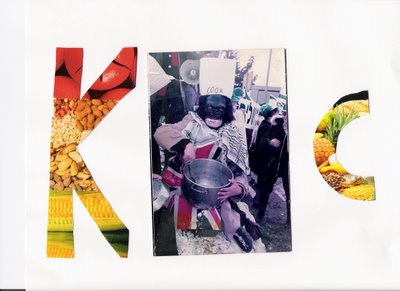
(Newcomers: It's the Kosher Cooking Carnival, not the Kosher Kooking Karnival, and that's a man in a gorilla suit, not a man in blackface. Relax.)
Brownie Update II
I posted a second update on the brownies at Kosherblog and forgot to cross-post it here. The gist of it is, ignore everything I said in my last post and use canola oil.
Sunday, August 20, 2006
Brownie Update
I've made these brownies several times since I posted the recipe, and I've started to realize that, while the dairy version is indeed the ultimate, the parve version could stand some improvement. The main issue, I think, is that the saturated fat in butter gives the brownies a lush, moist texture that the margarines I've used don't match. Hydrogenated oils should theoretically provide the same texture, but Fleischmann's Unsalted Margarine probably doesn't have enough. (It is significantly softer than butter at the same temperature.) Recently, I tried Smart Balance, and the brownies were downright dry. In this case, I think that the issue was simplify fat: Regular Smart Balance is 67% fat, while butter is about 80%. The package says that Smart Balance is "great for cooking and baking," but don't be fooled.
One option would be to switch to Crisco vegetable shortening, a favorite of a friend and former roommate of mine. Vegetable shortening (like regular margarine) is somewhat out of favor right now because it is high in trans fat, which, though once thought to be more healthful than saturated fat, is now generally believed to be worse. Nonetheless, as I've been implying, it takes a bit of saturated or trans fat to achieve that butterlike texture. Vegetable shortening has less water than most margarine, so it may be just right.
Anyhow, I'll keep you posted. Not right away, though. I really do have to cut back.
(Cross-posted to Kosherblog.)
Wednesday, August 02, 2006
Tisha B'Av Reading II
Rahel on Wouk
Dovbear on Judah Ha-Levi
Gil on the Holocaust theodicy
Soferet has the words of Rabbi Itzchak Marmorstein on transforming our inner wickedness.
The Velveteen Rabbi has a roundup and a story.
Rabbi Riskin on the hope for truth and peace.
Am Echad poses the question his own way.
Tzvi presents a paradox.
Dovbear on Judah Ha-Levi.
Soferet on the nature of the true tzaddik.
Tisha B'Av Reading
It is traditional not to read for pleasure on Tisha B'Av, or even to engage in Torah study that is not directly related to the themes of the holiday. On the other hand, as much as emotionally heavy reading comes with the territory, it can be difficult to handle intellectually heavy reading when you're fasting. Appropriate blog posts seem like just the right thing, so for the past few summers, I've been keeping my eyes open for Tisha B'Av reading in the blogosphere. Here's what I've found:
General
The "miscellaneous" category usually comes at the end of a list, but these are some of the best Tisha B'Av posts I've read, so I'm listing them first:
This essay by Rabbi Joshua Yuter addresses the historical significance of Tisha B'Av (or lack thereof). Rabbi Yehonatan Chipman addresses a number of issues in this lengthy but worthwile post, including divine and human justice. He discusses the haftarah for Tisha B'Av morning here, Maimonedes' laws for the final meal here, and Psalm 137 here. All are, characteristically, very good reads.
The Contemporary Problem
For many centuries, I believe, mourning for Jerusalem came naturally to most Jews. Their experience was one of continuing exile, and they longed to return to the glorious past in which the Jews were a nation with a homeland, a respected leader, and a central place of worship. The Enlightenment, with its promise of emancipation, complicated matters as many Jews began to see more promise in the ideal of integration than in the old messianic dream. Another wrinkle came in 1967, when that dream was partly fulfilled. Notwithstanding all the problems that have plagued Israel and Jerusalem since then, it can be difficult to mourn the destruction and loss of a city that now stands intact, well-populated, and generally prosperous. The problem is expressed poignently in this post by Out-of-Step Jew.
One contemporary approach to Tisha B'Av is simply to mourn less, either by de-emphasizing Tisha B'Av in various ways, or by shortening the fast. (The Conservative Movement, characteristically, has two official responsa on the subject, one calling for the fast to be shortened and one prohibiting any such change.) In this post, BZ explains why he finds both the Zionist and Enlightenment arguments against observing a full day of mourning equally uncompelling. His approach to Tisha B'Av is, I think, similar to the one that I articulated last year.
Those of us who continue to observe Tisha B'Av as a full day of mourning may relate most easily to the human suffering described in Eicha (Lamentations) and the kinot (liturgical laments). This is the basis for the way in which Orthoprax relates to Tisha B'Av as an observant atheist, as well as the (obviously distinct) way in which Rachel Barenblatt relates to it as a Reform Jew. It is also central to the way in which I related to the fast two years ago. Viewing Tisha B'Av through this prism can be constructive if it encourages us to help alleviate suffering, as Rachel suggests here, here, and here, and as Mishkaneer suggests here. It also has its drawbacks, however, as it ignores the more particular aspects of the holiday.
Another way to approach Tisha B'Av is to focus on the call for repentence that is so intimately linked to the threat of destruction and promise of redemption in prophetic writings. Dr. Mendel Hirsch, son of Rabbi Samson Raphael Hirsch, viewed the moral imperative stressed by the prophets as the most important aspect of Tisha B'Av. Dovbear discusses his teachings here and here. (It is surely relevant that S. R. Hirsch devoted his career to combatting the challenges posed by the Enlightenment.) Josh Yuter takes a similar approach in this d'var torah.
DH proposed a more existential approach to Tisha B'Av last year, in a post that stressed the sense of helplessness that we so often feel in the face of history. He related this idea to his feelings about the Gaza pullout, but I think it has even greater resonance this year, with the latest series of foreboding developments in the Middle East.
Liturgy
The traditional Tisha B'Av liturgy is frought with difficulties for the modern Jew. The most obvious problem is that the kinnot are very difficult for the average synagogue-goer to understand, even if he or she is generally familiar with Jewish liturgy. They are written in medieval Hebrew that is often quite different from both modern Hebrew and the Hebrew of most Jewish prayers, and they are so replete with biblical and midrashic references that some can be baffling even in translation. Another issue is bringing the liturgy up to date. Most traditional communties recite kinnot for the Crusades, the Inquisition, and various pogroms in addition to the destruction of the two temples, but some are reluctant to add lamentations for Holocaust and other recent tragedies. Finally, parts of the nachem prayer recited in the afternoon amidah seem inappropriate now that Jerusalem is under Jewish sovereignty.
Menachem Butler provides an excerpt from Rav Soloveichik's writings in which the rabbi discusses his opposition to introducing new kinnot. Leaving aside his actual argument (to which), I tend to think that it is more important for liturgy to mean something to the worshipper than to be artistically or even spiritually refined. However, finding appropriate kinnot for the Holocaust is not so easy. We chose an English poem this year, which I may write about later.
Yehonatan Chipman has posted some versions of the nachem prayer that account for the current political situation. This post by Rabbi Gil Student discusses the positions of some prominant Orthodox rabbis on making such changes. (Note that most of the rabbis cited seem to subscribe to my position #2.)
Personal Reflections
The ways in which individuals relate to Tisha B'Av emotionally can be very different. This poem by Chaim Nahman Bialik describes the poet's encounter with an abandoned beyt midrash (house of study) in the language of Lamentations and Isaiah. (Adderabbi discusses the poem here.) We J-Bloggers tend to be a bit more prosaic, literally and figuratively. Estelle Feldman shares her thoughts on the destruction of the two Temples after visiting the site the Twin Towers. Naomi Chana describes a moment in Rome in which she became seriously pissed at Titus. Fleurdelis28 writes of the difficulty of seeing other people's points of view and relates the Jewish exile to Les Miserables. Soferet began to truly mourn after receiving a blessing from a British rabbi. Barefoot Jewess laments the destruction of her homes and the distance she feels from her community.
Is all this really relevant to Tisha B'Av? I'm not sure. I still feel that the ancient paradigm is broken, so I tend to seek meaning in random, disparate places. Each of these posts seemed as moving or thought-provoking at one point or another. I hope that others find something in them as well.
Monday, July 31, 2006
And Everybody Hates the Jews
Sometimes I think that Jews over-emphasize anti-Semitism, but there sure are a lot of people out there who hate us. Anti-Semitic rhetoric from the Muslim world has become so ubiquitous that we hardly notice it. Then some deranged monster shoots up the Jewish Federation building in Seattle.
And of course, there's Mel Gibson. Ever since I heard about his "incident," I haven't been able to stop thinking about the South Park episode, "The Passion of the Jew." Especially Kyle's last line: "Oh, dude, I feel so much better about being Jewish now that I see that Mel Gibson is just a big wacko douche."
You have to find the humor in these situations whenever you can. If you don't laugh, you'll cry.
UPDATE: More bad news from Australia and Florida
Wednesday, July 26, 2006
Food for the Nine Days
Today is Rosh Chodesh Av, the first of the nine days of mourning that culminate in Tisha B'Av. There is a custom* not to eat meat during this period (except on Shabbat), so I've been posting recipes for easy meatless meals over at Kosherblog. They can be found here, here, here, and here.
Writing up these recipes, I realized how much DH and I have learned from each other about cooking. Before we started eating meals together, for example, he had never made anything with tofu and I had never cooked fish. Fortunately, we both had good training -- our mothers are excellent cooks, albeit with very different styles. Still, I feel that I have a way to go before I reach my full potential.
For better or for worse, however, that is not my top priority right now. Maybe I could learn something from DH's work ethic. . .
*Not, as the Wikipedia stub implies, a law. Someone should change that.
Wednesday, July 19, 2006
In Defense of Democracy
There's a particular argument that I've been hearing rather frequently lately, and it's beginning to get on my nerves. Here is one articulation, from the Shaigetz:
If you've been reading this blog for a while, you know that I've been ambivalent about the Iraq war from the outset. I am ambivalent about most matters of U.S. and Israeli foreign policy, which is one of the reasons why you won't find much discussion of them here. All that I mean to say in this post is that I don't think the current situation in the Middle East warrants the conclusion that Arabs, Persians, etc. are inferior races incapable of self-government. (The liberal version of this claim is that we shouldn't interfere with other cultures -- because apparently oppressive, fundamentalist governments are fine and dandy as long as they aren't composed of white Christians. To this I say: When other cultures interfere with us, we have a right to interfere with them.)
Now that I've gotten that off my chest, I'll probably retreat back into the comfortable world of dessert recipes. For good, first-hand takes on the war, I recommend An Unsealed Room and On the Face (both blogs that I thought were fizzling out before the conflict). There are also some good reads on this Lebanese blog aggregator, including LP and Rampurple.
Also from Lebanon: A satirical TV clip making fun of Nasrallah. It apparently caused riots, which is all the more reason to watch it.
Democracy, the doctrine that claims to allow the masses to determine the general direction of their governance, has replaced religion for many as the panacea for all the worldÂ’s ills. A peek at the Middle East today should be enough to shake even the dimmest of brains out of that reverie....A group of bloodthirsty savages, believers in the Ashariyya doctrine - that because all that happens is caused by God anyway it is legitimate to kill innocents, will not suddenly turn into cuddly lambs just because they were empowered through a ballot box.All right. Here's how it's supposed to work: The people vote and elect whomever they choose. If the elected leaders decide to interfere with the peace of other nations, those nations have the right to respond aggressively. After that, if the citizens of the new democracy don't like the consequences of their decision, they can elect new leaders who are more likely to protect their interests. It isn't neat. It isn't pretty. And, so far, there haven't been many signs that it is going to work in Iraq, Lebanon, or the Palestinian territories. But let's not forget that the old Mideast policy -- propping up dictators -- didn't work out too well, either. At least with democracy there is the possibility of peaceful change.
If you've been reading this blog for a while, you know that I've been ambivalent about the Iraq war from the outset. I am ambivalent about most matters of U.S. and Israeli foreign policy, which is one of the reasons why you won't find much discussion of them here. All that I mean to say in this post is that I don't think the current situation in the Middle East warrants the conclusion that Arabs, Persians, etc. are inferior races incapable of self-government. (The liberal version of this claim is that we shouldn't interfere with other cultures -- because apparently oppressive, fundamentalist governments are fine and dandy as long as they aren't composed of white Christians. To this I say: When other cultures interfere with us, we have a right to interfere with them.)
Now that I've gotten that off my chest, I'll probably retreat back into the comfortable world of dessert recipes. For good, first-hand takes on the war, I recommend An Unsealed Room and On the Face (both blogs that I thought were fizzling out before the conflict). There are also some good reads on this Lebanese blog aggregator, including LP and Rampurple.
Also from Lebanon: A satirical TV clip making fun of Nasrallah. It apparently caused riots, which is all the more reason to watch it.
Sunday, July 16, 2006
The Ultimate Brownies (Really!)
If Chanit can blog about food under these circumstances, I guess I can, too. And there's good news from Elfland: I think I finally found my brownie recipe.
I've tried quite a few recipes for brownies, and, with one notable exception, none of them were bad. Still, they didn't live up to my idea of what great brownies should taste like. The closest were "Fudge Brownies Supreme," from Nancy Baggett's All-American Cookie Book, but they were too sweet for my taste. This modified version of Baggett's recipe yields rich, lucious, intensely chocolately brownies that satisfy like nothing else.
Enjoy:
Cross-posted to Kosherblog.
I've tried quite a few recipes for brownies, and, with one notable exception, none of them were bad. Still, they didn't live up to my idea of what great brownies should taste like. The closest were "Fudge Brownies Supreme," from Nancy Baggett's All-American Cookie Book, but they were too sweet for my taste. This modified version of Baggett's recipe yields rich, lucious, intensely chocolately brownies that satisfy like nothing else.
Enjoy:
1/2 cup (1 stick) plus 2 tablespoons butter or margarine, or 1/2 cup canola oil
5 ounces unsweetened chocolate
2/3 cup all-purpose flour
1 1/2 tablespoons cocoa
1/4 teaspoon salt
1 cup granulated sugar
1/4 cup light brown sugar
3 eggs
2 1/2 teaspoons vanilla extract
Preheat oven to 350 degrees F. Grease an 8-inch square baking pan or coat with nonstick spray.
In a large, microwave safe bowl, microwave the butter and chocolate until the butter is completely melted (about 2 minutes). Remove from microwave and stir to finish melting the chocolate and blend the two ingredients. (Alternatively, melt in a saucepan over low heat). Let cool to warm.
In a small bowl, thoroughly stir toegether the flour, cocoa powder, and salt; set aside. Stir the sugar and brown sugar into the chocolate-butter mixture until well combined. Add eggs, one at a time, stirring after each addition. Add vanilla and stir until the sugar dissolves and the mixture is well blended and smooth. Stir in the flour mixture until evenly incorporated. Turn out the batter into the baking pan, spreading to the edges.
Bake in the middle of the oven for 20-30 minutes, or until a toothpick comes out moist but clean. (It's okay if the bottom 1/4 inch is still a bit fudgy.) Cool on a wire rack. Cut into squares, wiping the knife clean between cuts.
Store in an airtight container for up to 3 days or freeze for up to 1 month.
Cross-posted to Kosherblog.
Thursday, July 13, 2006
No Hekhsher Required
A recent Kosherblog post by Jabbett discussed the ethics of kashrut agencies certifying products that do not actually require rabbinic supervision. The post focuses on rubbing alcohol, which clearly does not require certification, as it is inedible (and also toxic). However, there are many edible products that do not require certification, either -- some less intiuitive than others. It is mainly due to ignorance that the very observant (even many rabbis) tend to insist that all processed foods be certified kosher.
This ignorance is fully understandable. Distinguishing between products that require rabbinic supervision and products that do not requires thorough knowledge of both the laws of kashrut and modern food processing techniques, and the latter may change at any time. In the age of the Internet, however, there is no reason why the kosher-keeping public should not be kept up-to-date on such matters. So I was happy to discover this site, via a comment by Jabbett on his own post. Rav Eidlitz is a renowned authority in the area of kashrut and is not affiliated with any particular certifying agency. His site contains a great deal of valuable information on keeping kosher, including a list of products that do not require rabbinic supervision. Here are a few that may surprise some readers:
Coconut Milk (not from China)
Corn (plain and cream style - frozen or canned)
Couscous (unseasoned)
Miso (unflavored)
Nori
Rice Pasta (containing only rice flour and water)
Wasabi Powder
There are certainly some things on Rav Eidlitz's site that are debatable, but for basic information on kosher products, it's a great placed to start. (While you're there, you should read the Kosher Alerts, although they are sometimes upsetting.)
Oh, and stay tuned: Jabbett is planning to post a more comprehensive list at Kosherblog.
UPDATE: DH says that he has known about this site for "a long time." Thanks for telling me! (J/K)
Wednesday, July 12, 2006
The Fast of the Fourth
Today is the Seventeenth of Tammuz, a fast day commemorating the fall of Jerusalem to the Babylonians in the sixth century B.C.E. The Seventeenth of Tammuz is intimately linked to the Ninth of Av, which occurs three weeks later and commemorates the destruction of the temple.
The book of Zechariah, which takes place in the years following the Jews' return from exile in the fifth century B.C.E., relates that a number of prominent individuals asked the prophet whether they should continue to mourn the destruction of the temple in the month of Av now that the Jews had been restored to their land and the temple was being rebuilt (Zech. 7:3). In classic Jewish fashion, Zechariah answered a question with a question:
The prophecy proceeds to relate the story of the preceding exile and restoration in theological terms. Before the exile, God sent prophets to tell the Israelites to "execute true justice; deal loyally and compassionately with one another" (7:10). Because they did not heed the prophetic message, the people were exiled. Now, however, they have been restored.
Though admittedly ambiguous, Zechariah's response seems to suggest that his questioners are missing the point. Fasting and mourning are merely human responses to tragedy. The divine imperative is to act justly and thereby avoid the conditions that led to tragedy in the first place. The prophet seems optimistic that the new Jewish commonwealth will be blessed with truth and justice, peace and prosperity, and the admiration of surrounding peoples. Thus, he declares:
The four fasts mentioned by Zechariah are traditionally taken to refer to the four fasts commemorating the downfall of the first commonwealth: the Seventeenth of Tammuz (the "fast of the fourth month"), the Ninth of Av (the "fast of the fifth month"), the Fast of Gedaliah (the "fast of the seventh month"), and the Tenth of Tevet (the "fast of the tenth month").
The rabbis of the Talmud, turning to this text for halakhic guidance, were understandably perplexed. Focusing on the wording of Zech. 8:19, they ask (b. Rosh Hashanah 18b), "They are called 'fasts' and they are called 'occasions for joy and gladness'" -- which is it? The Gemara answers that these days are to be observed as happy occasions in times of peace and as fasts in times when there is no peace. Rav Papa adds that when the situation is ambiguous, "if they wish, they shall fast; if they wish, they need not fast."
Rabbi Yehonatan Chipman notes that, while the fasts were observed by nearly all Jewish communities after the destruction of the second temple, some prominent rabbis considered changing the custom following the unification of Jerusalem in 1967. All agreed that the Ninth of Av should continue to be observed as a fast day, since the temple had not been rebuilt. The other fast days, however, commemorated the loss of Jerusalem, and Jerusalem had been regained. On the first Seventeenth of Tammuz following the Six-Day war, many Jews in Israel and abroad made festive meals. The abolition of the fast, however, did not ultimately take hold in observant communities. And so here I am today, observing the fast.
Is this as it should be? From a halakhic perspective, Chipman notes, there are arguments to be made on either side. Rashi interprets the Gemara's "times of peace" as a reference to Jewish sovereignty, which would suggest that all the fasts (including the Ninth of Av) should be observed as feasts today. Maimonides and Rabbeinu Hannanel, on the other hand, suggest that these days should all be observed as fasts as long as the temple lies in ruins. In a less traditional vein, I would suggest that the fasts should continue to be observeded because the society that Zechariah envisioned -- one of truth and justice, international recognition, and above all, peace -- has not become reality. At times, it may seem that that the fulfillmentnt of that vision is within reach, and that may justify a relaxation of the traditional mourning rites. This week, sadly, is not one of those times.
With seven Israeli soldiers killed, two kidnapped, and the beginning of what Yossi Klein Halevi calls "Israel's next war," there is a great deal to pray for. Avraham Hein offers a psalm as well as the official prayer for IDF soldiers, which can be added to the traditional fast day prayers or recited at any time.
May the One Who Releases the Bound return the captured soldiers to their families. May the One Who Comforts Mourners console the bereaved among the other mourners of Zion and Jerusalem. And may the One Who Makes Peace in the Heavens bring peace to Israel, now, speedily, and soon.
The book of Zechariah, which takes place in the years following the Jews' return from exile in the fifth century B.C.E., relates that a number of prominent individuals asked the prophet whether they should continue to mourn the destruction of the temple in the month of Av now that the Jews had been restored to their land and the temple was being rebuilt (Zech. 7:3). In classic Jewish fashion, Zechariah answered a question with a question:
When you fasted and lamented in the fifth and seventh months all these seventy years, did you fast for my [God's] benefit? And when you eat and drink, who but you does the eating, and who but you does the drinking (7:5-6)?
The prophecy proceeds to relate the story of the preceding exile and restoration in theological terms. Before the exile, God sent prophets to tell the Israelites to "execute true justice; deal loyally and compassionately with one another" (7:10). Because they did not heed the prophetic message, the people were exiled. Now, however, they have been restored.
For thus said the Lord of Hosts: Just as I planned to afflict you when your fathers provoked Me to anger and did not relent ... so, at this time, I have turned and planned to do good to Jerusalem and to the House of Judah. Have no fear! These are the things you are to do: Speak the truth to one another, judge honestly, and render judgements of peace in your gates (8:14-17).
Though admittedly ambiguous, Zechariah's response seems to suggest that his questioners are missing the point. Fasting and mourning are merely human responses to tragedy. The divine imperative is to act justly and thereby avoid the conditions that led to tragedy in the first place. The prophet seems optimistic that the new Jewish commonwealth will be blessed with truth and justice, peace and prosperity, and the admiration of surrounding peoples. Thus, he declares:
The fast of the fourth month, the fast of the fifth month, the fast of the seventh month, and the fast of the tenth month shall become occasions for joy and gladness, happy festivals for the House of Judah; but you must love truth and peace (8:19).
The four fasts mentioned by Zechariah are traditionally taken to refer to the four fasts commemorating the downfall of the first commonwealth: the Seventeenth of Tammuz (the "fast of the fourth month"), the Ninth of Av (the "fast of the fifth month"), the Fast of Gedaliah (the "fast of the seventh month"), and the Tenth of Tevet (the "fast of the tenth month").
The rabbis of the Talmud, turning to this text for halakhic guidance, were understandably perplexed. Focusing on the wording of Zech. 8:19, they ask (b. Rosh Hashanah 18b), "They are called 'fasts' and they are called 'occasions for joy and gladness'" -- which is it? The Gemara answers that these days are to be observed as happy occasions in times of peace and as fasts in times when there is no peace. Rav Papa adds that when the situation is ambiguous, "if they wish, they shall fast; if they wish, they need not fast."
Rabbi Yehonatan Chipman notes that, while the fasts were observed by nearly all Jewish communities after the destruction of the second temple, some prominent rabbis considered changing the custom following the unification of Jerusalem in 1967. All agreed that the Ninth of Av should continue to be observed as a fast day, since the temple had not been rebuilt. The other fast days, however, commemorated the loss of Jerusalem, and Jerusalem had been regained. On the first Seventeenth of Tammuz following the Six-Day war, many Jews in Israel and abroad made festive meals. The abolition of the fast, however, did not ultimately take hold in observant communities. And so here I am today, observing the fast.
Is this as it should be? From a halakhic perspective, Chipman notes, there are arguments to be made on either side. Rashi interprets the Gemara's "times of peace" as a reference to Jewish sovereignty, which would suggest that all the fasts (including the Ninth of Av) should be observed as feasts today. Maimonides and Rabbeinu Hannanel, on the other hand, suggest that these days should all be observed as fasts as long as the temple lies in ruins. In a less traditional vein, I would suggest that the fasts should continue to be observeded because the society that Zechariah envisioned -- one of truth and justice, international recognition, and above all, peace -- has not become reality. At times, it may seem that that the fulfillmentnt of that vision is within reach, and that may justify a relaxation of the traditional mourning rites. This week, sadly, is not one of those times.
With seven Israeli soldiers killed, two kidnapped, and the beginning of what Yossi Klein Halevi calls "Israel's next war," there is a great deal to pray for. Avraham Hein offers a psalm as well as the official prayer for IDF soldiers, which can be added to the traditional fast day prayers or recited at any time.
May the One Who Releases the Bound return the captured soldiers to their families. May the One Who Comforts Mourners console the bereaved among the other mourners of Zion and Jerusalem. And may the One Who Makes Peace in the Heavens bring peace to Israel, now, speedily, and soon.
Tuesday, July 11, 2006
Bread of Affliction?
Have you ever been tempted to buy Ezekiel 4:9 Bread just because of its name? I haven't.
When God tells Ezekiel to make bread from wheat, barley, beans, lentils, millet, and spelt, He's describing the type of food that the Jews would be forced to eat in exile. Normal bread would have been made from wheat flour alone, as it is today. This bread, in contrast, is made from all kinds of garbage. It's supposed to taste like crap. Ezekiel even cooks it over crap (though in those days, that was considered normal). The bread is actually supposed to be cooked over human crap, but the prophet manages to wriggle out of that one and upgrade to bovine crap.
At any rate, it isn't supposed to be good.
The producers of Ezekiel 4:9 bread explain why we should be expected to eat this stuff:
Truth be told, it doesn't taste like crap. It tastes pretty much like bread. There's a mild sourdough-like flavor in the background and a hint of sprouts that I think I might even develop a taste for over time. Or not. But I'll certainly finish the package.
This experience has led me to reconsider Ezekiel's so-called ordeal. He got to lie around for a year and a half and eat reasonably decent, high-protein bread that he didn't have to cook over human dung after all. Compared to marrying a cheating prostitute (Hosea) or walking around wearing yoke-bars (Jeremiah), that really doesn't seem so bad.
Cross-posted to Kosherblog.
When God tells Ezekiel to make bread from wheat, barley, beans, lentils, millet, and spelt, He's describing the type of food that the Jews would be forced to eat in exile. Normal bread would have been made from wheat flour alone, as it is today. This bread, in contrast, is made from all kinds of garbage. It's supposed to taste like crap. Ezekiel even cooks it over crap (though in those days, that was considered normal). The bread is actually supposed to be cooked over human crap, but the prophet manages to wriggle out of that one and upgrade to bovine crap.
At any rate, it isn't supposed to be good.
The producers of Ezekiel 4:9 bread explain why we should be expected to eat this stuff:
We discovered when these six grains and legumes are sprouted and combined, an amazing thing happens. A complete protein is created that closely parallels the protein found in milk and eggs.Of course, they could have created the same whole protein from any combination of grains and legumes. But never mind; they decided to follow God's recipe, and the result is, in fact, quite nutritious, with a full 4 grams of protein per slice in addition to three grams of dietary fiber. So when a friend left town and gave me her leftover Ezekiel 4:9 bread, I was willing to try it.
Truth be told, it doesn't taste like crap. It tastes pretty much like bread. There's a mild sourdough-like flavor in the background and a hint of sprouts that I think I might even develop a taste for over time. Or not. But I'll certainly finish the package.
This experience has led me to reconsider Ezekiel's so-called ordeal. He got to lie around for a year and a half and eat reasonably decent, high-protein bread that he didn't have to cook over human dung after all. Compared to marrying a cheating prostitute (Hosea) or walking around wearing yoke-bars (Jeremiah), that really doesn't seem so bad.
Cross-posted to Kosherblog.
Thursday, July 06, 2006
Camping Pics
DH has great pics from our camping trip. FYI, that brook is our shower. How cool is that?! (Okay, DH didn't think it was very cool either.) Swimming in Laurel Pond is definitely cool, though. I love that pond. And the froggies. Not the mosquitoes, though. (I'm still itchy.)
Progressive Faith Blog Con
 I often neglect to check the e-mail account that I use for this blog, so I just found out about the Progressive Faith Blog Conference, which will be held at the Montclair State University conference center on the weekend of July 14th. I won't be able to make it personally, and, truth be told, that's a bit of a relief. Although I do sometimes embrace a genuinely progressive theology, most of the time my religious side is not very progressive and my progressive side is not very liberal. Being around real religious liberals tends to make me more aware of the inconsistencies of my position and send me hurtling to the right, which I'm not really up for right now.
However, the con looks like it will be a lot of fun for those who are less schizophrenic than me. It also seems to be pretty well organized. This is the website, and this is the blog (of course there's a blog!). If, like me, you won't be attending in person, stay tuned: there may be a live chat during the con, and there will undoubtedly be updates from the participants.
Subscribe to:
Posts (Atom)


